


How Effective Are Viscosity Improvers Compared to Traditional Thickeners?
- Brandon Alata
- Jul 14, 2025
- 2 min read


In the constantly evolving world of lubricants, performance and efficiency are key. Among the many lubricant additives used to enhance performance, viscosity improvers stand out for their crucial role in maintaining optimal lubricant flow characteristics across varying temperatures. But how do these modern additives compare with traditional thickeners? Let’s explore the effectiveness of viscosity improvers in today’s lubrication technologies.
Understanding Viscosity Improver
Viscosity improvers, also known as viscosity index improvers, are polymer-based additives that help lubricants maintain a more consistent viscosity over a wide temperature range. These additives are particularly valuable in automotive and industrial applications where machinery and engines operate in both hot and cold environments.
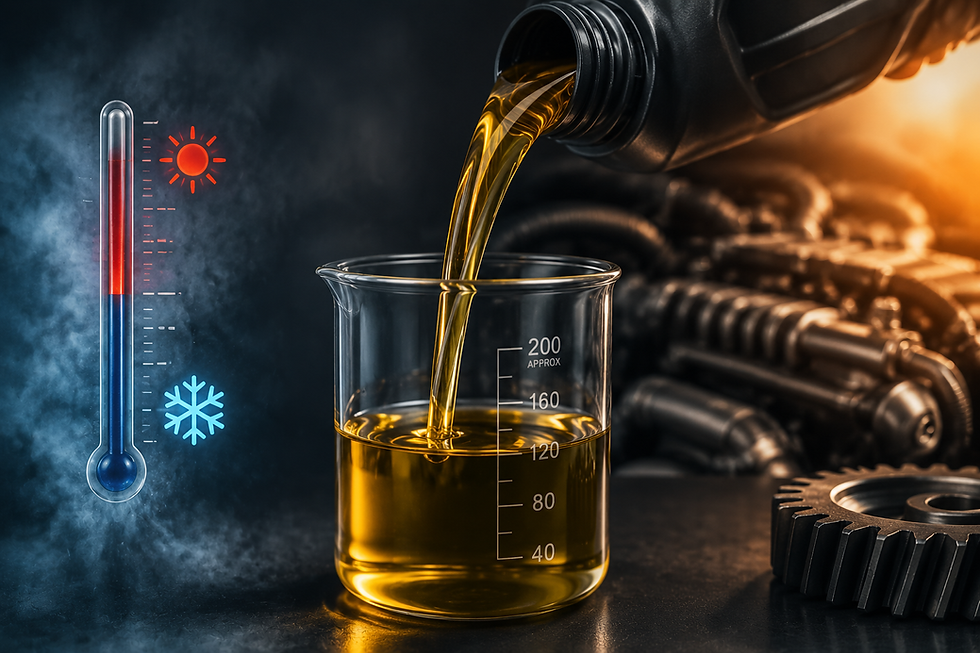
When temperatures drop, oils naturally thicken; when they rise, oils tend to thin out. Viscosity improvers reduce this variability, ensuring that the lubricant flows easily during startup while still providing adequate film strength at high temperatures. This results in better wear protection, reduced energy loss, and extended equipment life.
What Are Traditional Thickeners?
Traditional thickeners, often made from soaps, clays, or other fibrous materials, have been used for decades to increase the viscosity of lubricating oils or greases. While effective in thickening, they generally lack temperature sensitivity, meaning the thickening effect is consistent regardless of the operating conditions.
Unlike viscosity improvers, traditional thickeners do not adapt to temperature fluctuations. They serve primarily to maintain oil body at a static level but don’t contribute to dynamic viscosity control in fluctuating thermal environments.
Effectiveness of Viscosity Improvers Over Traditional Thickeners
1. Thermal Responsiveness
Viscosity improvers excel where traditional thickeners fall short: in responding to temperature changes. Their polymeric structure expands at high temperatures and contracts at low temperatures, allowing oils to maintain optimal flow and protection. This makes them especially suited for multi-grade engine oils used in modern vehicles.
2. Fuel Efficiency
By stabilizing oil viscosity and reducing internal friction, viscosity improvers can contribute to better fuel economy. Traditional thickeners, by contrast, can increase drag in the engine due to their constant bulk, especially in cold-start situations.
3. Wear Protection
Lubricants enhanced with viscosity improvers maintain a stable lubricating film across wide temperature ranges. This minimizes metal-to-metal contact and reduces wear. Traditional thickeners provide some level of cushioning but are less effective in dynamic, high-stress environments.
4. Compatibility and Versatility
Viscosity improvers are more compatible with a wide range of lubricant additives, including anti-wear agents, detergents, and dispersants. This allows formulators to create multi-functional, high-performance lubricants. Traditional thickeners, while effective in specific grease applications, lack this level of formulation flexibility.
Limitations of Viscosity Improvers
Despite their advantages, viscosity improvers are not without drawbacks. They can degrade under extreme mechanical stress (a process known as shear thinning), leading to loss of viscosity control over time. However, advancements in polymer chemistry have significantly improved the shear stability of modern viscosity improvers.
Conclusion
In the debate between viscosity improvers and traditional thickeners, it’s clear that for modern, temperature-sensitive applications—particularly in the automotive and industrial sectors—viscosity improvers offer superior performance. Their ability to enhance lubricant flow, protect engine components, and work synergistically with other lubricant additives makes them an essential part of any high-performance lubrication strategy.
As lubrication technology advances, the role of viscosity improvers will only become more critical in meeting the demanding requirements of efficiency, durability, and environmental compliance.
Comments