


- Brandon Alata
- Aug 12
- 4 min read

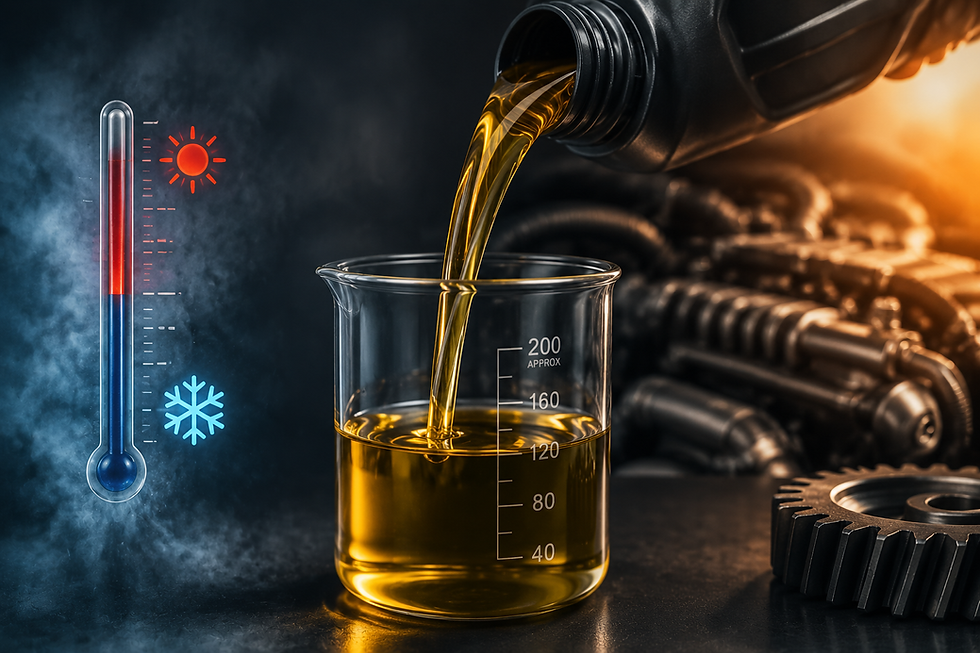
A lubricant has a difficult job. It needs to remain fluid enough to move through an engine or mechanical system when temperatures are low, yet maintain sufficient thickness when the equipment becomes hot. Getting that balance right is essential for reducing friction, protecting components, and maintaining reliable performance.
This challenge becomes particularly relevant in the UAE, where equipment can operate in high ambient temperatures and demanding industrial conditions. A lubricant that becomes too thin under heat may struggle to maintain an effective protective film.
This is where viscosity improver polymers play an important role. These specialised additives help control how a lubricant's viscosity changes as temperature rises or falls, allowing the finished formulation to perform across a wider operating range.
Why Lubricant Viscosity Changes With Temperature
Viscosity describes a fluid's resistance to flow. Temperature has a direct effect on it.
When lubricant temperature falls, the oil generally becomes thicker and flows more slowly. During cold starts, this can make it harder for oil to circulate quickly through the system.
As temperature increases, the lubricant becomes thinner. If it becomes excessively thin, the oil film between moving surfaces may become less effective, potentially increasing friction and wear.
For equipment operating across changing temperatures, neither extreme is desirable. Lubricant formulators therefore aim for a controlled viscosity profile.
What Are Viscosity Improver Polymers?
Viscosity improver polymers are long-chain polymeric additives used to modify the temperature-dependent viscosity behaviour of lubricants.
At lower temperatures, these polymer molecules have less influence on the lubricant's flow behaviour. As temperature increases, the polymer chains expand and interact more strongly with the surrounding oil, helping the lubricant retain more of its viscosity than it otherwise would.
This allows a formulation to maintain a more useful viscosity range as operating temperature changes.
The technology is commonly associated with multigrade engine oils and other lubricants where temperature performance is important.
How They Support High-Temperature Performance
High operating temperatures can cause conventional lubricants to become significantly thinner.
For equipment working under heavy loads or extended operating cycles, maintaining an adequate oil film is critical. If viscosity falls too far, the lubricant may not provide the desired level of separation between moving surfaces.
Viscosity improvers help reduce the rate at which the lubricant's viscosity falls as temperature rises.
This does not mean they prevent thinning completely. Instead, they help control the degree of viscosity change and contribute to a more stable performance profile within the lubricant's intended operating range.
Supporting Better Cold-Start Flow
It may seem contradictory to want an oil that remains thick at high temperatures but flows easily when cold. That is exactly the challenge lubricant formulators face.
A suitable viscosity improver can help a lubricant achieve this balance.
During a cold start, the lubricant still needs to circulate through relevant components without creating excessive resistance. Once the engine or machinery reaches operating temperature, the polymer helps the formulation maintain greater viscosity than the base oil alone might provide.
This balance is one reason multigrade lubricants are widely used in applications exposed to varying temperatures.
Why Polymer Quality Matters
Not all viscosity improvers perform in exactly the same way.
Their effectiveness depends on polymer chemistry, molecular structure, concentration, base oil compatibility, shear stability, and the requirements of the finished lubricant.
Mechanical systems can subject polymers to intense shear forces. If a polymer breaks down excessively under these conditions, the lubricant may experience a permanent loss of viscosity.
For this reason, lubricant manufacturers consider shear stability carefully when selecting viscosity improver polymers.
The Importance of Shear Stability
Imagine a lubricant circulating continuously through a heavily loaded mechanical system. The oil passes through narrow clearances, pumps, gears, and other components where it can experience mechanical stress.
A viscosity improver that cannot withstand these conditions may lose part of its effectiveness over time.
Shear-stable polymer technology can help the lubricant retain its intended viscosity characteristics for longer, depending on the application and formulation.
This can be particularly relevant for automotive, industrial, hydraulic, and transmission lubricants where consistent performance matters.
Choosing the Right Viscosity Improver for UAE Conditions
UAE operating environments can present significant thermal demands. Vehicles, construction equipment, generators, industrial machinery, and other systems may operate for extended periods in high ambient temperatures.
When selecting a viscosity improver, formulators should consider:
Base oil type and quality
Target viscosity grade
Operating temperature range
Equipment type
Shear conditions
Desired service interval
Oxidation stability requirements
Compatibility with other additives
Performance specifications
The goal is not simply to add a viscosity improver. It is to create a balanced lubricant formulation that performs reliably throughout its intended service conditions.
Final Thoughts
Temperature can significantly influence lubricant behaviour, and maintaining the right viscosity is essential for protecting mechanical components. Viscosity improver polymers give formulators another tool for balancing low-temperature flow with high-temperature viscosity retention.
For lubricant manufacturers and industrial businesses serving the UAE market, selecting the right polymer technology requires careful consideration of the base oil, operating conditions, equipment, and performance requirements.
Looking to improve a lubricant formulation? Work with an experienced additive supplier to evaluate your application and select viscosity improver polymers that support the temperature performance, shear stability, and specifications your lubricant requires.
FAQs
What is the main purpose of a viscosity improver?
A viscosity improver helps control how significantly a lubricant's viscosity changes with temperature, supporting useful performance across a wider temperature range.
What are viscosity improver polymers?
They are polymeric lubricant additives designed to modify temperature-viscosity behaviour. They are commonly used in multigrade lubricant formulations.
Why is shear stability important?
Mechanical shear can break down some polymer structures, potentially causing permanent viscosity loss. Good shear stability helps the lubricant maintain its intended characteristics during service.
Are viscosity improvers useful in hot UAE conditions?
Yes. They can help lubricant formulations maintain appropriate viscosity characteristics as temperatures rise, although the overall formulation and application requirements determine final performance.
